Loading...
Serving Great Falls, MT and surrounding areas. (406) 216-0672
Great Falls Insulation serves Kalispell with crawl space insulation, attic insulation, and spray foam - responding within 1 business day and providing free on-site estimates throughout the Flathead Valley.
Kalispell gets around 60 inches of snow per year, and when it melts in April and May, wet crawl spaces are one of the most common problems older homes in the Flathead Valley face. Crawl space insulation combined with a proper vapor barrier stops ground moisture, warms up floors, and protects pipes and framing from the damage that wet crawl spaces cause over time.
The heavy snow loads that Kalispell sees every winter sit on roofs for weeks at a time, and ice dams at the eaves are a direct result of heat escaping through an under-insulated attic. Older homes built in the 1950s through 1970s - which represent a large share of Kalispell's housing stock - typically have a thin settled layer in the attic that is nowhere near what this mountain valley climate actually demands.
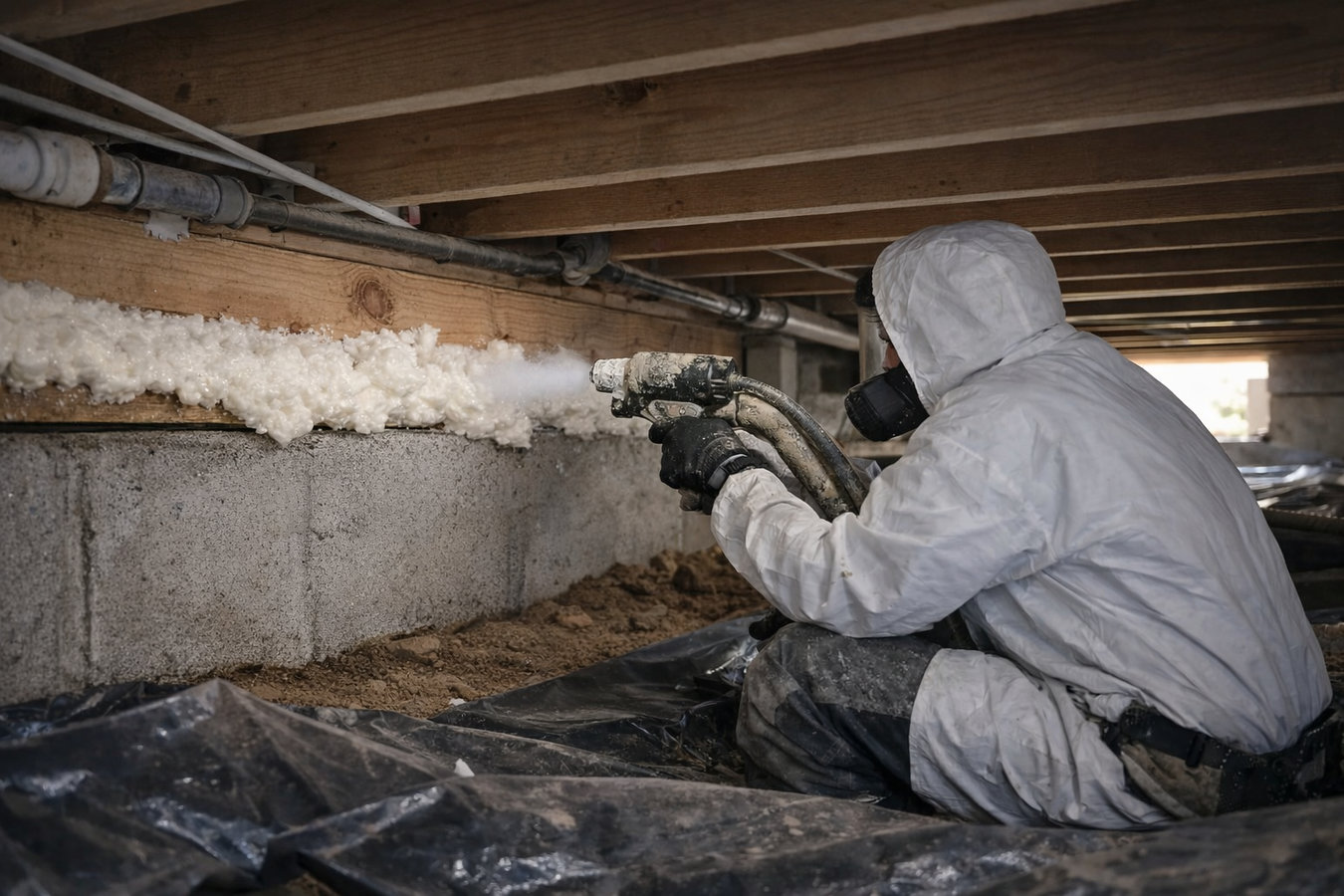
Kalispell's freeze-thaw cycles crack foundations and open gaps in rim joists and foundation sills that standard batt insulation cannot fully address. Spray foam expands to seal those gaps and insulate in a single step - making it the strongest choice for crawl space walls, rim joists, and any area in a Flathead Valley home where both cold air infiltration and moisture are active problems.
In a city where spring snowmelt pushes moisture up through the ground for weeks at a time, a proper vapor barrier in the crawl space is not a minor add-on - it is what keeps ground moisture from soaking into floor joists, degrading insulation, and creating the conditions for mold and rot. Clay-heavy soils in parts of the Flathead Valley hold moisture longer than sandy soils, which makes a well-installed barrier more important here than in drier parts of Montana.
Kalispell's older wood-frame homes have attic joist bays with irregular blocking and framing that batts never fill completely. Blown-in loose-fill material fills those irregular spaces and is one of the most cost-effective ways to bring a pre-1980 Kalispell attic up to the insulation depth that 60 inches of annual snowfall and sub-zero January temperatures actually require.
Kalispell's temperature swings between seasons are wide - warm dry summers followed by hard winters with heavy snow and extended cold below zero. Those swings stress every joint and penetration in a home's exterior, opening small gaps that add up to significant air leakage over time. Air sealing before insulation goes in is what makes the rest of the work actually hold its rated performance through a full Flathead Valley winter.
Kalispell sits in a valley surrounded by mountains and forest, about 35 miles from the west entrance of Glacier National Park. That setting is beautiful, but it also means the city takes on a demanding climate year-round. Kalispell averages around 60 inches of snow per year, and January temperatures regularly drop below zero. The valley location can trap cold air, making winters feel colder than the elevation alone would suggest. When that snowpack melts in April and May, the ground is often still partially frozen, and the resulting moisture has nowhere quick to go - wet basements, damp crawl spaces, and overwhelmed drainage systems are recurring problems for homeowners here. Any insulation contractor working in this area needs to account for both the cold and the moisture, not treat them as separate problems.
The city's housing stock spans two distinct eras. The older in-town neighborhoods near downtown Kalispell have wood-frame homes built between the 1940s and 1970s, many with original wood siding, crawl spaces or partial basements, and insulation that has settled or degraded significantly over the decades. These homes were built before modern energy codes, and many have never had a meaningful insulation upgrade. Layered on top of that older inventory is a significant wave of newer construction - subdivisions built in the 2000s and 2010s that spread south and west of the original city core. Those newer homes face the same heavy snow loads and spring moisture but have different framing, tighter building envelopes, and different upgrade needs than their older counterparts. Understanding which type of home you are working on changes the approach in ways that matter.
We pull permits through the City of Kalispell Building Department when projects require them and are familiar with what types of insulation work in this municipality trigger a permit versus what moves forward without one. Working on the older homes near downtown means knowing what crawl space clearance looks like in a 1950s Kalispell house, how that framing is laid out, and where moisture damage is most likely to show up. For newer subdivision homes, the framing and access are different, but the crawl space moisture risk from Flathead Valley snowmelt is the same regardless of when the house was built.
The city stretches from the walkable historic downtown district out to newer subdivisions on the south and west edges, with US Highway 2 and US Highway 93 running through as the main routes. We work efficiently throughout Kalispell and the broader Flathead Valley - from the older neighborhoods near the city core to the newer streets spreading toward the edge of town. Whether a home is a block from downtown or out near the newer developments, we know the area and show up ready.
We also serve homeowners in the communities surrounding Kalispell throughout the Flathead Valley. Residents in Whitefish, MT - just north of Kalispell up the valley - face the same mountain climate and the same crawl space moisture concerns that come with heavy snowpack and spring runoff. We respond to inquiries from both communities within 1 business day and schedule free estimates throughout northwest Montana.
We respond within 1 business day. You do not need to have everything figured out - describe what you are noticing (wet crawl space after snowmelt, cold floors, ice dams, high heating bills) and we take it from there. No sales pressure on the first call.
We visit your Kalispell home, inspect the crawl space, attic, or target area, and give you a written quote that breaks down scope, materials, and total cost. We address cost upfront and tell you whether your project needs a City of Kalispell permit - no surprises once work begins.
The crew arrives with all equipment and handles the job from start to finish. Most Kalispell residential jobs finish in a single day. Spray foam projects require you and your pets to leave the home for two to four hours after application while the foam cures and the space is ventilated.
We walk you through the finished work before packing up - you see the vapor barrier placement, the insulation coverage, and any areas we flagged during the job. If a permit was pulled, we coordinate the inspector follow-up directly with the Kalispell Building Department.
We serve Flathead Valley homeowners with free estimates and 1-business-day response - no pressure, no guesswork about what it will cost.
(406) 216-0672Kalispell is the Flathead County seat and the largest city in northwest Montana, with a population of around 26,000 residents. It sits at the northern end of the Flathead Valley, flanked by mountains and positioned close to both Flathead Lake - the largest natural freshwater lake west of the Mississippi - and the west entrance of Glacier National Park about 35 miles to the north. The city serves as the commercial and service hub for a wide region, drawing residents from Whitefish, Columbia Falls, and smaller communities throughout the valley for shopping, medical care, and services. Downtown Kalispell has a walkable historic core of late 19th and early 20th century brick buildings, and the surrounding residential neighborhoods reflect more than a century of growth, from modest postwar bungalows to newer construction spreading south and west.
Most of Kalispell's older in-town neighborhoods are single-family homes on mid-size lots with mature trees and detached garages. A large share of these homes were built between the 1940s and 1970s - well before modern energy codes - and many have crawl spaces or partial basements that have seen varying degrees of moisture over the years. The broader Flathead Valley includes communities to the north and south that share the same mountain climate and many of the same housing challenges. We serve homeowners in Whitefish, MT just up the valley, as well as Missoula, MT to the south, where mountain winters and older housing stock create similar insulation demands.
High-performance spray foam that seals and insulates in a single application.
Learn moreLoose-fill insulation that fills every gap for consistent, even coverage.
Learn moreWhole-home insulation services that improve comfort and reduce energy bills.
Learn moreDense, moisture-resistant closed-cell foam for maximum thermal performance.
Learn moreFlexible open-cell foam providing excellent sound dampening and insulation.
Learn moreSeal attic bypasses to prevent conditioned air from escaping through the roof.
Learn moreHeavy-duty vapor barriers that protect crawl spaces from moisture damage.
Learn moreProfessional vapor barrier installation for basements and crawl spaces.
Learn moreAdd insulation to existing walls and structures without major renovation.
Learn moreCommercial-grade insulation solutions for offices, warehouses, and more.
Learn moreServing these cities and communities.
We serve Flathead Valley homeowners and respond within 1 business day. Call or fill out the form to get started.